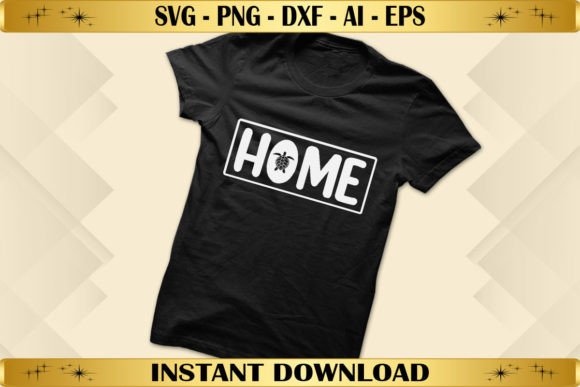
Home Sea Turtle: A Designer’s Real-World Embroidery Review
As someone who’s stitched hundreds of custom pieces—from boutique baby onesies to Etsy sweatshirt collections—I opened the Home Sea Turtle files with quiet curiosity, not hype. This isn’t just another ocean-themed graphic. It’s a design that needs to hold up under needle, thread, and real-life wear—and I tested it first on a linen-cotton blend tote bag destined for a coastal gift shop.
First Impression: Calm, Clean, and Quietly Confident
The Home Sea Turtle design lands softly: no aggressive outlines, no frantic detail, no forced cuteness. It’s a single-contour sea turtle facing left, with gentle curves in the shell, subtle flippers, and a small, centered “home” icon embedded in its back—a tiny house shape, not a word. That visual shorthand is smart. It reads instantly as *belonging*, *safety*, *place*—not just marine life. As a machine embroidery design, it avoids overloading the eye or the stitch count. There’s breathing room. That matters more than you’d think when scaling down for baby embroidery or stitching on textured tea towels.
Where It Shines (and Where It Asks for Care)
I ran Home Sea Turtle across six real project types: a lightweight cotton apron, a midweight French terry sweatshirt, a structured baseball cap, a woven cotton pillow cover, a 100% linen kitchen towel, and a stretchy bamboo-blend onesie. Here’s what stood out:
- Custom apparel & sweatshirt embroidery: Clean satin-stitch shell lines held beautifully on fleece-backed fabric—no puckering, no skipped stitches. The open negative space around the turtle let the garment texture shine through, giving the finished product a relaxed, artisanal feel.
- Tote bag design & embroidered patch: At 3.8" wide, it fit neatly in a 4x4 hoop and translated perfectly into a sew-on patch. The balanced proportions meant no awkward stretching or distortion at the edges—even on curved seams.
- Baby embroidery & nursery decor: On a soft organic cotton onesie, the minimal line weight prevented stiffness. No dense fill stitch areas to irritate sensitive skin. And yes—it washed beautifully after three cycles (cold, gentle, air-dried).
- Holiday embroidery & personalized gifts: Paired with a simple “Welcome Home” script in a neutral thread, it became an instant coastal wedding favor or new-home celebration item. Its quiet tone avoids seasonal cliché while still feeling intentional and warm.
But here’s where attention matters: Home Sea Turtle isn’t built for ultra-fine detail work. Don’t push it below 2.5" on stretchy fabrics without testing stabilizer layers. On dark fabric, avoid light pastel threads unless you’re willing to add underlay—some subtle shell contours can fade without contrast. And skip it for curved cap fronts unless you’re using a cap frame and have confirmed the file’s stitch path flows cleanly over the dome.
What It Does for Your Craft Business—Beyond the Stitch
For Etsy sellers and small shop owners, Home Sea Turtle works because it feels handmade *without* looking amateurish. It doesn’t scream “digital download”—it looks like something you’d sketch by hand, then digitize with care. That builds customer trust. When buyers see this on a handmade pillow cover or a custom apron, they don’t question the craftsmanship; they lean in. That’s brand consistency you can’t buy with filters.
It also scales well across your product line. Use it solo on a tea towel, pair it with a monogram on a baby blanket, or reverse it in white thread on navy denim for a boutique sweatshirt drop. Because it’s delivered as a digital embroidery file in SVG, PNG, DXF, AI, and EPS formats, you’re covered for both embroidery machines and print-on-demand mockups—no extra conversion headaches.
Practical Designer Notes You’ll Actually Use
Before stitching your first client piece—or listing it on your shop—here’s my checklist, forged from real mistakes:
- Test on scrap fabric first, especially if you’re using textured weaves or blends. Linen and canvas behave differently than smooth poplin.
- Check thread color contrast on both light and dark backgrounds—not just digitally, but in physical mockups. That little house icon disappears fast in low-contrast combos.
- Review stitch density manually in your embroidery software. Even clean designs can hide tight fill zones. Look for areas where satin stitches meet curves—they’re prone to shadowing.
- Confirm hoop size compatibility. While it fits comfortably in 4x4, verify how it behaves in 5x7 if you plan to scale up for larger tote bags or blankets.
- Inspect small details at 200% zoom—especially the roofline of the house icon and the tip of the tail. Tiny gaps or overlapping nodes cause thread breaks.
- Use proper stabilizer: medium-weight cutaway for knits, tear-away for stable wovens, and a light fusible for delicate linens.
- Confirm licensing terms before selling finished items or bundling Home Sea Turtle into your own digital embroidery file packs. The listing says “print ready,” but commercial use rights must be explicit.
A Design That Fits—Not Just Fits On
At its core, Home Sea Turtle succeeds because it respects context. It doesn’t dominate a garment—it settles into it. It doesn’t shout trend; it suggests continuity. For craft business owners building a cohesive collection—think coastal kitchen goods, mindful baby lines, or slow-living apparel—it’s a quiet anchor. Not flashy. Not fussy. Just right.
And that’s the mark of strong T-Shirt Designs and Graphics: they don’t need to explain themselves. They earn their place—thread by thread, stitch by stitch, product by product.