Skilled Enough to Be a Welder
A Designer’s First Look: Bold, Witty, and Built for Personality
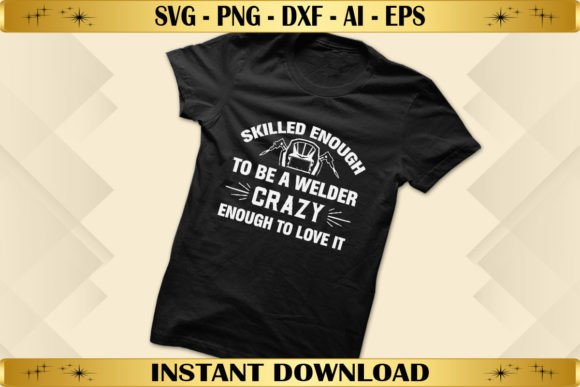
When I opened the Skilled Enough to Be a Welder design for the first time, my instinct wasn’t to check file formats—it was to imagine it stitched onto a heavyweight cotton tote bag, slung over the shoulder of a proud apprentice at a trade school open house. That’s the mood it lands: confident, grounded, quietly humorous, and unapologetically blue-collar. The layout is clean and horizontal—no excessive flourishes or decorative borders—just strong, legible lettering with subtle weight variation that suggests craftsmanship without demanding perfection. It doesn’t try to be cute or ironic; it *is* what it says it is. That authenticity makes it instantly usable across real embroidery projects—from custom apparel to boutique merchandise—without needing heavy reinterpretation.
Where This Design Shines in Real Embroidery Projects
I recently used Skilled Enough to Be a Welder on a 12-oz canvas apron for a local welding supply shop’s staff gift program. The result? Sharp, readable, and surprisingly warm—not just functional, but emotionally resonant. That’s its strength: it bridges utility and identity. On sweatshirts and crewnecks, it reads cleanly even at 3.5" wide. As a machine embroidery design for tote bags or tea towels, it holds up beautifully under medium-density fill stitch, especially when paired with a light stabilizer backing. For baby embroidery? Not ideal—its tone and scale skew adult, though it could work tastefully on a dad’s onesie or nursery wall banner if balanced with softer elements. As an embroidered patch or cap front design? Yes—but only on structured, flat-front panels. Avoid curved crowns unless you’re willing to adjust digitizing for distortion.
What Makes It Work for Small Business & Etsy Sellers
- Brand consistency: It reinforces a no-nonsense, skilled-craft aesthetic—perfect for shops selling tools, safety gear, or handmade workshop goods.
- Giftability: Customers buy this not just as text, but as recognition—“You *are* skilled. You *do* love it.” That emotional hook lifts perceived value beyond typical T-Shirt Designs.
- Printable mockup flexibility: The included PNG and SVG files render crisply in lifestyle mockups—great for Etsy listings where visual clarity builds trust before purchase.
- Digital embroidery file versatility: With AI, EPS, DXF, and SVG included, it adapts well to both embroidery software (like Wilcom or Embrilliance) and vector-based prep workflows.
Where Caution Is Needed—Not Flaws, Just Realities
This isn’t a “set and forget” design for every surface. On thin or stretchy fabric—think lightweight tees or baby rib knit—stitch density can cause puckering if stabilizer choice isn’t dialed in. I recommend tear-away + light cutaway combo for knits, and always test on scrap first. Dark fabrics demand high-contrast thread colors; the design’s mid-weight letterforms don’t naturally pop on black without careful thread selection. And while the lettering is bold, the smallest details—the curve of the “g,” the inner counter of the “e”—won’t resolve cleanly below 2.75". So skip it for tiny hoop sizes (<3") or intricate layered garments like double-knit jackets.
Design Assets That Earn Their Place in Your Workflow
As a designer who evaluates hundreds of digital embroidery files yearly, I judge Skilled Enough to Be a Welder by how little it asks me to fix—and how much it lets me deliver. It doesn’t need reworking for commercial embroidery use, nor does it sacrifice legibility for style. Its simplicity is intentional, not minimal. That means faster hooping, fewer thread breaks, and more consistent results across batches—critical for craft business owners juggling Etsy orders, craft fair inventory, and wholesale requests. It also scales gracefully: shrink it slightly for a pocket detail on a denim jacket, or enlarge it thoughtfully (with proper redigitizing) for a large-format pillow cover. Just remember—scaling changes stitch density. Always verify that before final run.
Practical Notes Every Embroidery Designer Should Check
- Test the design on your exact fabric + stabilizer combo—not just generic cotton.
- Review stitch density in your embroidery software; adjust if needed for textured fabrics like terry cloth or fleece.
- Confirm hoop size compatibility—this design fits comfortably in a 4x4 hoop at standard width, but verify before batching.
- Inspect small interior details (like the “o” in “To”) in black-and-white mockups—they’ll show contrast issues faster than color previews.
- Compare thread color options against both light and dark backgrounds—what reads well on white may disappear on navy.
- Use proper stabilizer: medium-weight cutaway for stable wovens, soft tear-away + light cutaway for knits.
- Verify licensing terms before selling finished products—especially if listing digitally as Graphics or offering as part of a bundle.
Final Thought: A Design That Feels Like a Handshake
Skilled Enough to Be a Welder doesn’t shout. It stands. And in a market saturated with overly polished, algorithm-friendly graphics, that grounded presence is rare—and valuable. It works because it respects the craft it represents and the hands that will stitch it. Whether you’re embroidering a personalized gift for a new journeyman, stocking a boutique shelf with sweatshirt embroidery, or building cohesive design assets for a trades-focused brand, this one earns its place—not as decoration, but as quiet affirmation. That’s why it stays in my active project folder, not my archive.