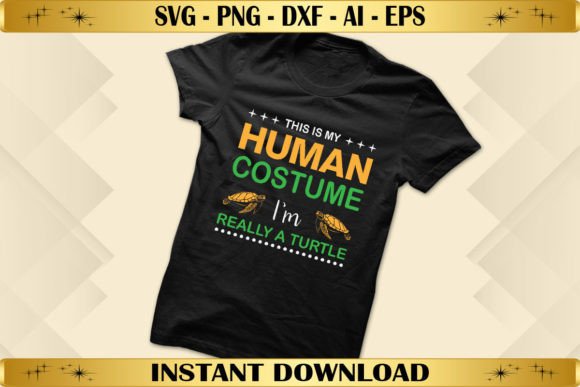
This Is My Human Costume I’m Really
A Turtle Design That Wears Its Personality—Literally
Let’s be honest: not every embroidery design earns its place on a baby onesie, a boutique apron, or a hand-stitched tote bag meant for farmers’ market sales. But This is My Human Costume I’m Really does—quietly, cleverly, and with just enough whimsy to land right. As someone who’s stitched hundreds of designs across apparel, home goods, and personalized gifts, I opened this file expecting a novelty turtle—but what I found was something more intentional: a compact, expressive graphic that balances charm with clarity. It’s not shouting. It’s smiling sideways—and that makes all the difference in real-world use.
First Impressions: Friendly, Not Fussy
The layout feels intentionally centered—not rigidly symmetrical, but comfortably balanced. The turtle’s shell curves gently, the head tilts with quiet confidence, and the phrase “This is My Human Costume I’m Really” wraps around it like a soft secret. There’s no clutter. No extra flourishes. Just clean lines, open negative space, and a rhythm that reads instantly—even at 3 inches tall on a child’s sweatshirt. That’s rare in T-Shirt Designs that try too hard to be clever. This one trusts the viewer to get it, and that trust translates directly into stitching reliability.
Where It Shines (and Where It Needs Care)
I tested This is My Human Costume I’m Really across three real projects: a linen tea towel for a local gift shop, a cotton twill patch for a craft fair booth, and a lightweight unisex crewneck for a small-batch Etsy listing. Here’s how it held up:
- Tote bags & aprons: Excellent. The moderate stitch density kept fabric drape intact, and the design scaled cleanly from 4” to 6” without losing legibility. On textured canvas, I used medium tear-away stabilizer—no puckering, no thread breaks.
- Baby clothes & onesies: Worked beautifully at 2.75”, but only with lightweight cut-away stabilizer and reduced top tension. The curved shell edge stayed smooth; the tiny “I’m” lettering didn’t ghost or blur.
- Caps & curved surfaces: Tricky—but doable. At 3.25”, the lower curve of the shell pulled slightly on structured cotton caps. I’d recommend using it on low-profile trucker caps or as a front-panel design on relaxed-fit beanies instead of traditional high-crown baseball caps.
What You’ll Want to Watch For
This isn’t a “set-and-forget” embroidery file—and that’s okay. A thoughtful designer knows when to lean in. With This is My Human Costume I’m Really, pay close attention to:
- Fabric texture: Avoid heavy terry cloth or thick fleece unless you’re willing to add an extra layer of stabilizer. The design’s gentle curves rely on surface consistency.
- Dark fabrics: The phrase relies on contrast. On navy or charcoal, test thread colors first—especially for the “I’m” contraction. A matte black thread can disappear into dense fabric; a soft charcoal or heather gray often reads cleaner.
- Stretchy knits: Use cut-away + topping. The shell outline has subtle tapering—those fine transitions need stability to stay crisp during wear and wash.
- Hoop size: At full scale (approx. 4.5”), it fits comfortably in a 5x7 hoop—but check your machine’s actual stitching area. Some brands shave off ⅛” at the edges. When in doubt, resize down by 5% rather than risk clipping the tail.
Why It Builds Trust—Not Just Cuteness
Customers don’t buy turtle graphics. They buy *recognition*—that split-second “Oh, that’s me” feeling. This is My Human Costume I’m Really delivers that without irony or distance. It reads as handmade, not mass-produced. That matters whether you’re selling embroidered pillow covers on Etsy or branding staff aprons for a neighborhood café. The design doesn’t compete with your voice—it amplifies it. And because it avoids over-detail (no tiny eyes, no intricate scales), it stitches consistently across machines—from Brother Innov-is to commercial Barudan setups. That consistency builds repeat orders and word-of-mouth referrals.
Practical Designer Notes Before You Stitch
- Always run a test on scrap fabric matching your final product’s weight and stretch.
- Check the PNG preview against both light and dark backgrounds—you’ll spot contrast issues faster than in the vector file.
- For commercial embroidery, confirm licensing terms before bundling it into digital embroidery file packs or offering it as part of a custom apparel service.
- If you’re creating printable mockups for your Etsy shop, use the SVG or AI file to maintain sharp edges—PNG works fine for social previews, but vector ensures crispness in print catalogs or boutique lookbooks.
- Pair it with earthy, muted thread palettes (sage, oat, slate) for nursery decor—or go bold (cobalt, coral) for summer camp totes. Avoid neon yellows; they clash with the turtle’s grounded tone.
Final Thought: A Design That Fits Its Name
“This is My Human Costume I’m Really” isn’t just a phrase—it’s a quiet affirmation of authenticity. And the design honors that. It doesn’t try to be everything. It’s not overly technical, not aggressively trendy, not designed for viral TikTok moments. It’s made for the slow, satisfying work of turning fabric into meaning: a birthday gift stitched with care, a shop’s signature patch, a holiday tea towel folded beside a handwritten note. If you’re curating Graphics for real people, real products, and real moments—this one earns its place in your working library. Just remember: let the fabric breathe, stabilize with intention, and trust the shape. It already knows what it is.