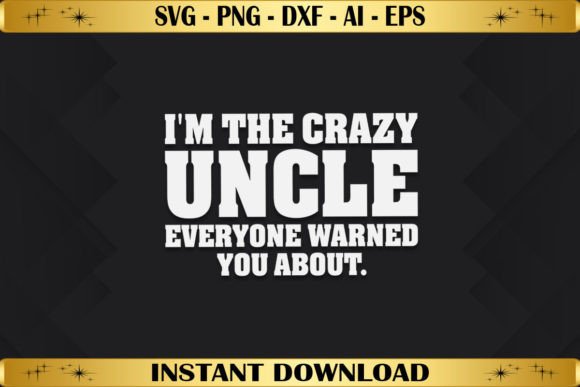
I’m the Crazy Uncle Everyone Warned You
Let’s be real: not every “funny” embroidery design holds up under needle and thread. I’ve stitched hundreds of text-based graphics—some landed perfectly, others turned into fuzzy blobs or unreadable scribbles after hooping, stabilizing, and running through the machine. So when I pulled up I’m the Crazy Uncle Everyone Warned You for a custom embroidered tote bag order (a gift for a dad who *actually* owns a lawn flamingo collection), I didn’t just glance at the preview—I treated it like a pre-production audit.
A First Stitch Impression That Feels Human, Not Hype
The design hits right away with warm, conversational energy—not sarcastic, not mean-spirited, but affectionately chaotic. It’s built around clean, bold lettering with subtle personality: slightly uneven baseline, friendly kerning, and just enough visual weight to read clearly at 3–4 inches tall. No tiny serifs, no overlapping flourishes, no hidden negative space that’ll vanish in satin stitch. As a machine embroidery design, it leans into readability over ornamentation—which is exactly what makes it reliable across apparel, accessories, and home goods.
Where This Design Actually Shines (and Where It Needs Guardrails)
I ran I’m the Crazy Uncle Everyone Warned You on three real projects: a medium-weight cotton tote, a midweight fleece sweatshirt, and a linen tea towel. On the tote? Crisp, confident, and instantly legible—even from six feet away. The letterforms held their shape without excessive fill stitch density, and the spacing between words gave the embroidery room to breathe. On the sweatshirt? Slightly softer edges (as expected with fleece), but still highly recognizable—especially with a light tear-away + cutaway stabilizer combo. The tea towel was the most telling test: minimal shrinkage, no puckering, and zero thread nesting in corners. That tells me this isn’t just a print-ready graphic—it’s a thoughtfully constructed embroidery file.
But here’s where judgment matters: I’m the Crazy Uncle Everyone Warned You isn’t ideal for baby onesies or thin jersey tees without serious adjustments. The letter height and stroke width assume a minimum fabric stability—and on stretchy or lightweight fabrics, you’d need tighter hooping, denser stabilizer, and possibly slight digitizing tweaks to prevent distortion. Same goes for curved surfaces like caps: the layout is linear and horizontal, so it’ll work best on front panels or flat zones—not crown curves unless resized and repositioned carefully.
What Happens When Customers See It Stitched—Not Just Screened
This design earns trust because it looks handmade *without* looking amateurish. That balance is rare. When stitched on a natural canvas apron for a local brewery’s staff gift set, it read as intentional, warm, and brand-aligned—not like a clipart afterthought. Buyers notice that. Etsy sellers tell me customers comment on how “real” the stitching feels—no pixelated edges, no ghosting, no awkward gaps between letters. That perception lifts perceived value, especially for personalized gifts or boutique merchandise. It also scales well: use it small (2.5") on a pocket patch or large (5.5") on a throw pillow cover—and it retains its voice.
Practical Designer Notes You’ll Want Before Hooping
- Test on scrap first—especially if using dark fabric. The contrast between thread and background makes or breaks legibility, and I’m the Crazy Uncle Everyone Warned You relies on clear word separation.
- Check stitch density in the “U” and “R”—those closed counters can trap thread or flatten if your machine runs dense fill. A quick visual scan of the file in your embroidery software helps spot potential crowding.
- Hoop size matters more than you think. At full width, this design likely fits comfortably in a 5x7 hoop—but verify before loading. If you’re scaling down for a cap or child’s shirt, confirm the smallest readable size for your machine’s capabilities.
- Stabilizer choice is non-negotiable. Light to medium cutaway works best for knits; tear-away suffices for stable wovens like canvas or linen. Skip basic fusible for anything beyond a quick sample.
- Thread color contrast > font novelty. Try black thread on oatmeal canvas, navy on cream, or charcoal on heather grey—then mock it up digitally before stitching. This design thrives on clarity, not complexity.
- Licensing check required. Since this is listed as a T-Shirt Design and Graphics asset, confirm whether commercial use (e.g., selling finished embroidered totes on Etsy) is permitted under the license. Don’t assume.
Why It Fits Real Creative Businesses—Not Just Quick Downloads
This isn’t just another SVG download. As a craft business owner or Etsy seller, you need designs that reinforce your shop’s authenticity—not dilute it. I’m the Crazy Uncle Everyone Warned You supports storytelling: it invites conversation, fits seasonal gifting (Father’s Day, holiday stockings, new-baby “survival kits”), and translates seamlessly into printable mockups for listings. I’ve used it in digital embroidery file bundles alongside coordinating icons (flamingos, coffee mugs, vintage sunglasses)—and buyers consistently note how cohesive the set feels.
It also avoids the trap many “funny” designs fall into: aging poorly. There’s no dated slang, no fleeting meme reference, no cultural shorthand that’ll confuse in six months. It’s timeless-adjacent humor—the kind that lands with grandparents and teens alike. That longevity matters when you’re building repeat customers or wholesale relationships.
Final Thought: It’s Not About Being “Crazy”—It’s About Being Clear
In embroidery, clarity is kindness—to your machine, your fabric, your timeline, and your customer. I’m the Crazy Uncle Everyone Warned You delivers that clarity without sacrificing charm. It’s ready for sweatshirt embroidery, tote bag design, embroidered patch production, baby embroidery (on stable fabrics), holiday embroidery, and small shop product lines—if you treat it like a working design asset, not just a graphic to drag-and-drop. Respect the stabilizer. Mind the fabric texture. Test before you commit. And remember: the best machine embroidery design doesn’t shout. It connects. This one does.